Polina Vytnova

My github contains raw code (in Fortran and C) used to study some dynamical systems I am interested in.


We call a circle packing the closure of a collection of circles on the complex plane (or on the Riemannian sphere) such that no two circles overlap and no circle can be enlarged without creating an overlap. A Kleinian group Γ acting on the sphere by Moebius transformations maps circles onto circles. Under certain extra assumptions the limit set of the group action turns out to be a circle packing. Such groups Γ can be roughly classified based on the geometry of the quotient space ℂ̅/Γ. The three large classes are free singly-degenerate cusp groups, such as Jørgensen's groups; free double-cusp groups; and non-free groups with Sierpiński type limit sets, that is groups whose limit set is homeomorphic either to the Sierpiński carpet. A proper description can be found, for instance, in a comprehensive survey by M. Kapovich here.
The Apollonian gasket is an example of a limit set of a double-cusp Kleinian group and is homeomorphic to the Sierpiński gasket. Its origin, however, precedes that of Kleinian groups and the Sierpiński gasket by about 2000 years, as we can trace its history back to the work of an ancient Greek geometer, Apollonius of Perga. A theorem of Apollonius, found in his fundamental work "Conics" (c. 200BCE) only surviving in Arabic translation, tells us that, given three mutually tangent circles, there are exactly two circles touching all of them. Hence we can construct, iteratively, an infinite collection 𝓐 of circles, such that for any three mutually tangent circles from this collection, there are another two γ1, γ2∈𝓐 tangent to all three. The closure of the resulting set 𝓐 c is the Apollonian gasket.
A slightly more recent theorem of Descartes (1643), that was found in his famous letter to the princess Elizabeth of Bohemia, implies that if the three initial mutually tangent circles have integer curvatures, then the curvatures of all circles in the packing are also integers. This simple observation is the basis for studying the Gasket from number-theoretic viewpoint. The construction implies that for every real number t>0 there exists just a finite number of circles with curvature smaller than t. One can ask how the number of such circles changes as t → ∞. In 2011, Kontorovich and Oh established the power law:
#{γ ∈ 𝓐 : curvature(γ) ≤ t } ∼ const ⋅ t δ,
where the constant δ is the Hausdorff dimension of the Apollonian gasket. The numerical value of δ has proved to be notoriously difficult to compute. This is because the (double cusp) Kleinian group associated to the gasket has parabolic generators. Namely, its generators are Moebius transformations with neutral fixed points where the derivative has absolute value 1. For nearly half a century, the best known estimate was due to Boyd (1973):1.300197 < δ = dimH𝓐 c < 1.314534.
In joint work with C. Wormell (2025), we gave an approach that allows us to compute the Hausdorff dimension of the Apollonian gasket to an arbitrary precision. To demonstrate its efficiency, we give 128 digits in the paper, and the first 60 are displayed in Figure 2b.
There is another curious number-theoretic property: the curvatures of circles in the integer packing are known to fall into one of six or eight residue classes modulo 24. The so-called local – global conjecture stated that every sufficiently large integer in each of these residue classes appears as a curvature in the packing. Recently, it was proved to be false.
For geometric aspects of surfaces that arise as quotient spaces of the Riemannian sphere with respect to the action of Kleinian groups, as well as higher-dimensional generalisations, and connections to homogeneous dynamics and some open questions, see an excellent survey by H. Oh in ICM-2026 proceedings here.
The continued fraction is an alternative way to represent a real number as a limit of a sequence of rational numbers. Recall that for a real number α its continued fraction is an expression of the form
| α = |
|
= a0+1/(a1+1/(a2+1/(a3+...))) = |
[a0; a1, a2, a3, ... ] |
||||||||||||
| 1 |
| x |
| [ | 1 | ] |
| x |
T: [0;a1,a2,a3...] ↦ [0;a2,a3,a4...]
It is therefore not invertible, but has infinitely many inverse branches Tj : x ↦| 1 |
| x + j |
Tj : [0;a1,a2,a3...] ↦ [0;j,a1,a2,a3...]
We may pick a pair of integers, say, 1 and 2 and consider an iterated function scheme of two inverse branches T1,T2. Then for any α∈[0,1] = [0;a1,a2,a3...] and for any sequence {jn} of 1s and 2s the imagesTjn...Tj3Tj2Tj1 : α= [0;a1,a2,a3...] ↦ [0;jn,...,j3,j2,j1,a1,a2,a3...]
converge to a number whose partial denominators are all either 1 or 2. The set of all such numbers has been well studied and even has a dedicated notation.C2 = {x ∈ (0,1) | x = [0; a1, a2, a3, ... ], where aj = 1 or aj = 2 for all indices j }.
It is a nonlinear Cantor set and it has a complex fractal structure. More generally, the sets which arise as limit sets of iterated function schemes of (a finite number of) the inverse branches Tj are called Gauss—Cantor sets. The Hausdorff dimension of C2 has now been computed to very high accuracy and we give 200 digits of it in Section 4.1.2 of our paper. For practical applications it is useful to know thatdimH C2 = 0.53128... > 0.5.
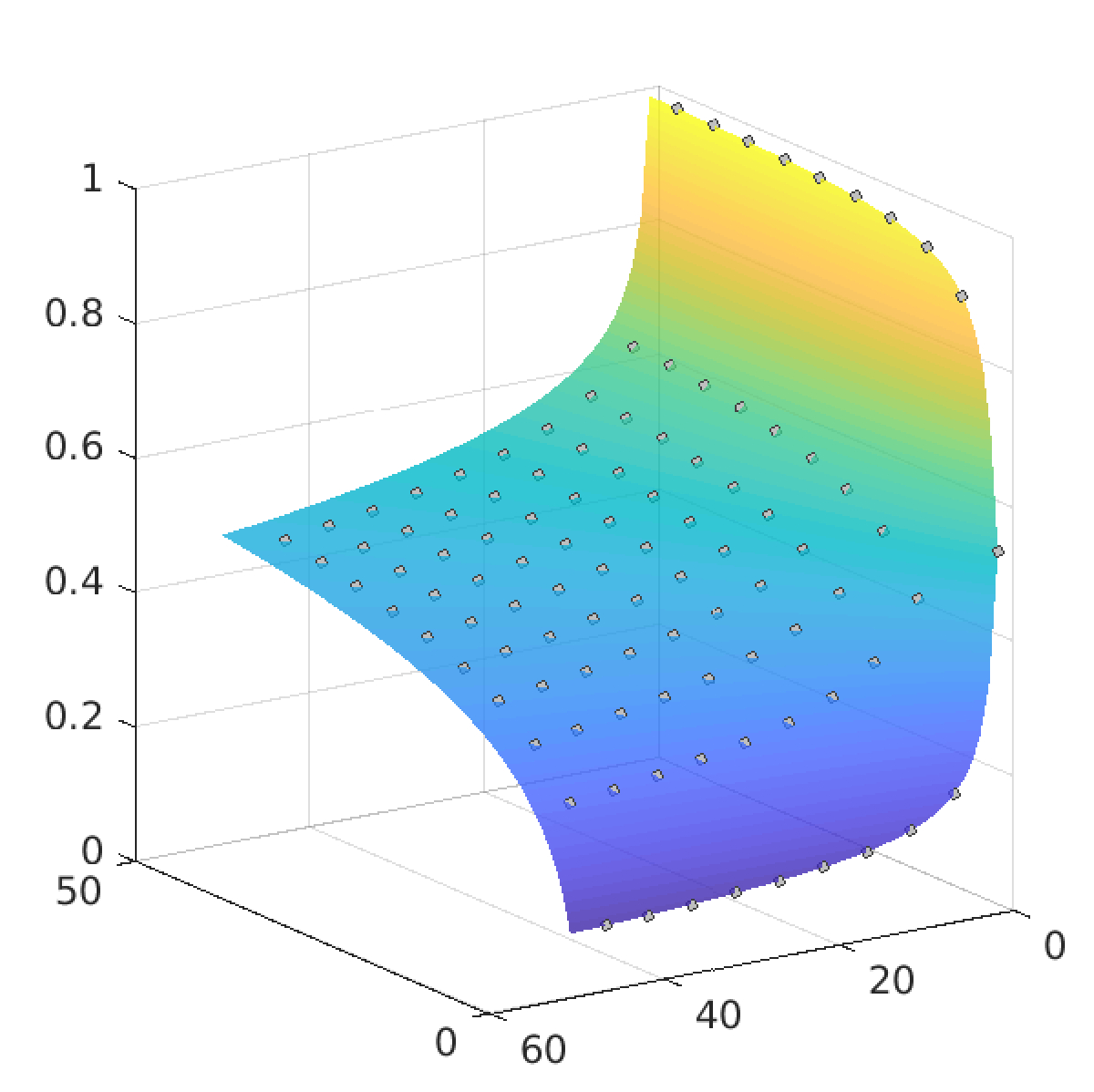
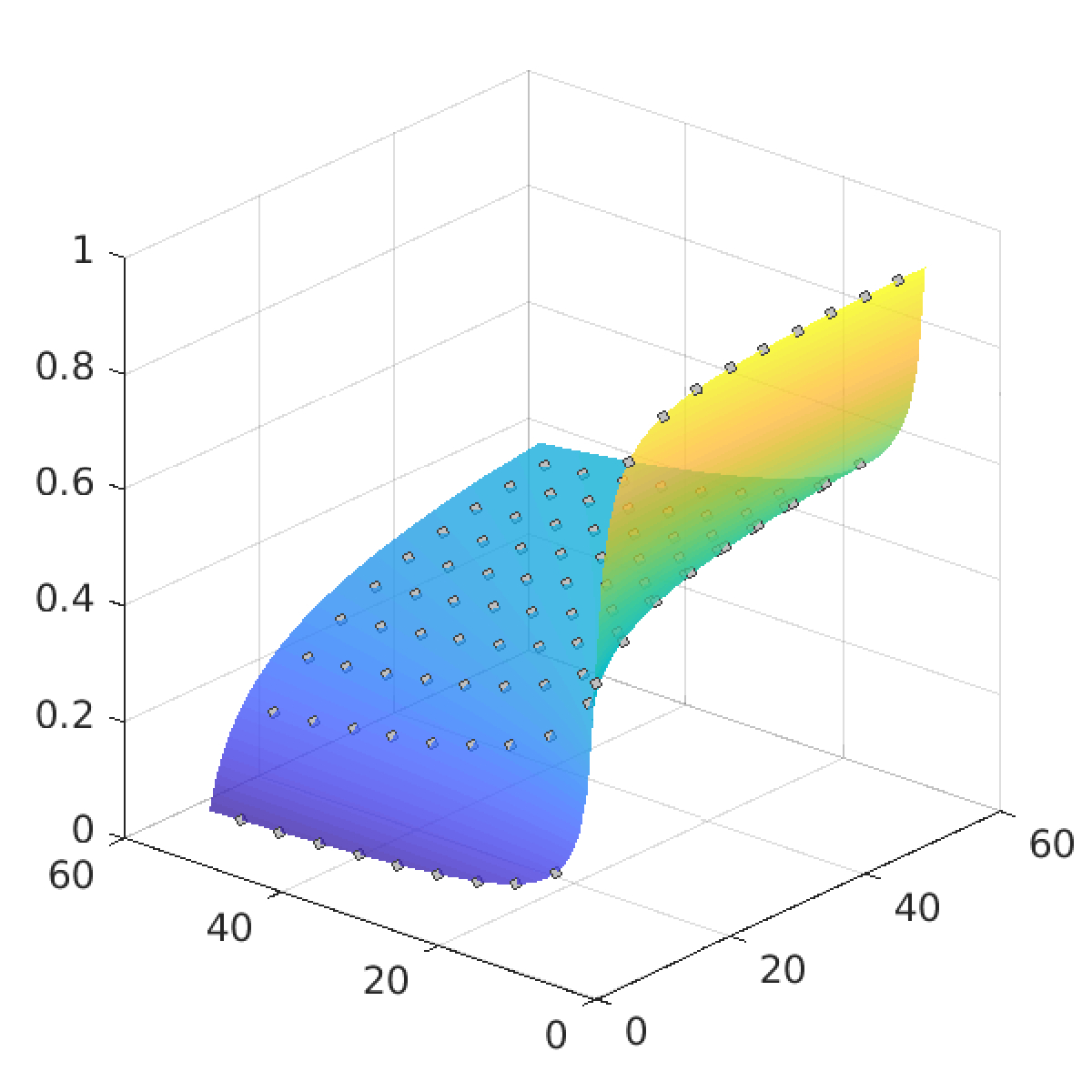
Figure 2a on the left depicts the dimension of a two-parameter family of setsEn,k = {x ∈ (0,1) | x = [0; a1, a2, a3, ... ], where aj ∈ {n, n+1, ... , n+k} for all indices j }
as a function of two variables d(n,k) = dimH En,k for n,k = 1, ... , 50 . The set C2 corresponds to the choices n = 1 and k = 1, so C2 = E1,1. The method we developed allows us to compute these 2500 values in just a few minutes with accuracy of 10−5. We see that for any fixed k0 the function d(n,k0) decreases rather rapidly as a function of n. For instance, in a special case k0 = 1 with only two digits n and n+1 in the expansion, we getd(2,1) = 0.3374... , d(3,1) = 0.2637... , d(50,1) = 0.0883....
On the other side of the parameter domain, when k0 = 50 we haved(1,50) = 0.9872..., d(2,50) = 0.8085..., d(50,50) = 0.4594....
Our algorithm enabled us to establish several estimates on the dimension of Gauss—Cantor sets, which are essential for the results on the density-one and modular forms of the Zaremba conjecture (pdf). Continued fractions also appear in Diophantine approximation in connection with the Markov and Lagrange spectra. The Markov spectrum first appeared in 1879–80 in work by A. A. Markov (father) on quadratic forms. Later, Perron gave an alternative definition, in terms of continued fractions. On a set of bi-infinite sequences of natural numbers, we may define a real-valued functionλ : {an} ↦ a0 + [0;a1,a2,a3...] + [0;a−1,a−2,a−3...] ∈ R.
Then the Markov number of {an} is defined as a limit of the values of λ along the trajectory of the Bernoulli shift σ : {an} ↦ {an+1} , namelym({an}) := limj→∞ λ(σj{an}).
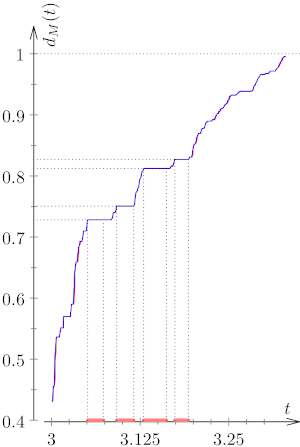
The (classical) Markov spectrum M is then defined as the set of all Markov numbers for all possible sequences of integers. It is known that (-∞,3) ∩ M is a discrete set and M ∩ (√21,+∞) is the entire ray. In the interval [3,√21] the Markov spectrum has rich fractal structure. Figure 2b on the left shows an approximation to the dimension of (-∞,t) ∩ M as a function of t. A recent result by C. G. Moreira shows that dM(t)=dimH((-∞,t) ∩ M) is a Cantor function, i.e. a continuous function which is locally constant on an open dense set. The approximation was calculated using the method we developed in our paper (joint with C. Matheus, C. G. Moreira and M. Pollicott), where we study other properties of the Markov spectrum and its closely related cousin called the Lagrange spectrum. The pink intervals show the gaps in the Markov spectrum, which are given, for instance, in the Cusick and Flahive’s textbook “Markov and Lagrange spectra” (published in 1991).PhD Thesis, University of Warwick,
under supervision of Dr. Oleg Kozlovski:
♜ Kinematic fast dynamo problem (pdf)
♜ Viva Talk Handout (pdf)
MRI Master Class project, University of Utrecht, under supervision of Prof. Yu. Kuznetsov:
♝ Accumulation of strong 1:2 resonances in generalised Hénon maps (pdf)
MSc Thesis, Independent University of Moscow, under supervision of Prof. G. Shabat:
♞ On nonarchimedean dynamical systems (pdf)